
Phone numbers
Fax: +264 (0)61 248344
Cell: +264 81 663 3224
Postal address
Windhoek
Namibia
Street address




NOA-Training-materials
Biochar: This poster series is a step-by-step guide to biochar production.
Biochar Poster Series
Fencing: This poster series highlights the aspects important to consider when building fences and gives an overview over fencing techniques and approaches.
Fence Construction Poster Series
Water harvesting: This poster series gives an overview over different approaches to harvest water without establishing major and expensive infrastructure, but focuses instead on methods of storing it in the ground, where roots can reach the water, and avoiding evaporation or drainage beyond the root zone.
Water Harvesting Poster Series
Rainfed alley cropping: This poster series introduces an agroforestry system applicable to Namibian farming conditions, highlighting the approach and benefits of such a system.
Rainfed Alley Cropping Poster Series
Organic Certification - NOA’s PGS
If you are interested in pursuing certification of your farm products, either raw or processed, a comprehensive guide on obtaining organic certification through NOA’s Participatory Guarantee System (PGS) is a useful first step to understanding the process of certification for the local market in Namibia. The booklet provides information on the steps to certification and the NOA marks to use on products after certification has been approved.
Full guide to certification under NOA’s PGS for the local market
Steps to certification under NOA’s PGS
Guide to organic crop production
Guide to organic processing and labelling
Namibian Organic Meat Factsheet
Factsheet 1 Organic meat production in Namibia
Factsheet 2 Benefit of organic grass-fed livestock
Factsheet 3 Organic slaughter & processing
Factsheet 4 Market opportunities for organic beef
Factsheet 5 Alternative Feed & Supplements for Organic Livestock
Facrsheet 6 Organic crop production for animal feed
Afrikaans Version- Organic Livestock
Factsheet 1 Organiese vleisproduksie in Namibië
Factsheet 2 Voordele van organies-veldafgeronde vee
Factsheet 3 Organiese slag en verwerking
Factsheet 4 Markgeleenthede vir organiese beesvleis
Factsheet 5 Alternatiewever en aanvullings vir organiese vee
Factsheet 6 Organiese gewasproduksie vir veevoer
Organic livestock production: Videos
The series of videos on organic livestock production is based on the content that is in the organic livestock factsheets. Footage was taken on Farm Krumhuk, an organic and biodynamic farm on the outskirts of Windhoek. Each video gives an introduction to key aspects of organic livestock management (e.g. sustainable grazing practices, adapted breeds, animal welfare and market opportunities for organic meat) and the health benefits of organic meat for the consumer.
Introduction to Organic Agriculture
Animal Welfare
Adapted Breeds
Sustainable Grazing
Feeding Organic Livestock
Health Benefits
Organic Markets
Regenerative grazing: Case studies
The three case studies highlighted in this publication are sourced from the National Agricultural Union’s work, "Regenerating Namibian Livestock Farmers," which supports the government’s 2019 Regenerative Livestock Production Strategy. These case studies illustrate how Namibian farmers are applying regenerative principles on their farms through sustainable grazing management systems. Each farm employs regenerative grazing methods in a way that suits the farm’s management principles and animals, in an effort to regenerate degraded land, to build soil health and avoid soil erosion, and to enhance resilience against challenges like climate shocks, including the recent drought. Additionally, these case studies showcase the benefits of a diversified farming approach, which results in increased production, improved profitability per hectare over time and better resource management..
Full case studies
Let us know what you think or enquire about details.
Email us at info@noa.org.na or 0816633224
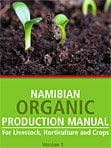
Namibia Organic Production Manual
Namibian Organic Production Manual
For Livestock, Horticulture and Crops
Organic Agriculture is an acknowledged sustainable method using natural resources, and therefore the development of the Namibian Organic Production Manuals was commissioned and financed by the GIZ Support to Land Reform Programme, on behalf of the Federal Republic of Germany and in close cooperation with the Namibian Organic Association (NOA).
NOA thanks german cooperation (Deutsche Zusammenarbeit) and Deutsche Gesellschaft für Internationale Zusammenarbeit (GIZ) GmbH for their invaluable support in producing this publication.
Foreword and index
Chapter 1
Organic agriculture: origins, principles and definition
Chapter 2
Soil fertility in organic agriculture
Chapter 3
Pest and disease control
Chapter 4
Weed and vegetation management
Chapter 5
Organic seed and plant production
Chapter 6
Organic certification
Chapter 7
Organic livestock production principles
Chapter 8
Organic and FANmeat cerification
Chapter 9
Animal welfare
Chapter 10
Animal nutrition and veterinary care
Chapter 11
Namibian specific production considerations
Chapter 12
Frequently asked questions
African Organic Training Manual
The African Organic Agriculture Training Manual project, which was started in October 2009 by the Research Institute of Organic Agriculture (www.fibl.org  ) aims at delivering and enabling best farming practices to farmers, farmer groups, extension workers and trainers.
The appropriate training materials will help extension workers to better address and communicate with small-holder farmers, and as a result encourage application of new technologies for sustainable agriculture. This training manual is a key ingredient in the dissemination of sustainable agriculture best practices.
African Organic Agriculture Training Manual
.
Legislation
The Biosafety Act, No. 7 of 2006, provides measures to regulate activities involving the research, development, production, marketing, transport, application and other uses of genetically modified organisms and specified products derived from genetically modified organisms. It establishes a Biosafety Council and defines its powers, functions and duties. It also makes provision for incidental matters.
Download the Act...
The Research, Science and Technology Act, No. 23 of 2004
The Research, Science and Technology Act, No. 23 of 2004, provides for the promotion, co-ordination and development of research, science and technology in Namibia. It establishes the National Commission on Research, Science and Technology and the National Research, Science and Technology Fund. It also makes provision for incidental matters.
Download the Act...
Living in Organic Times
Download the 2014 edition...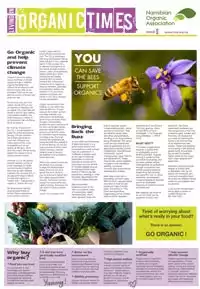 |
Download the 2013 edition...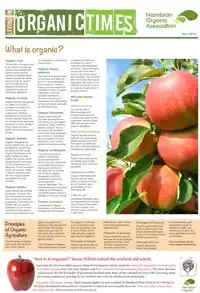 |
Download the 2012 edition...  |